
Rob Lovelace on all-weather investing
Originally written for Capital Group by Rob Lovelace
The world has changed.
We are living through a pivotal time in history, marked by geopolitical realignment, high inflation, volatile financial markets and the end of a 40-year period of declining interest rates. The title of this new era could be Brave New World or Back to the Future. But I think the title I would select is Revenge of the Boomers, because a lot of these events rhyme with the past, particularly the early 1960s. That’s when we saw interest rates bottom out after decades of decline, as well as the rise of the Cold War era, which is unfortunately rearing its head again in some respects.
Despite these challenges, I remain optimistic about the investing environment for several reasons. First, there are still signs of growth as the global economy recovers from the pandemic. Second, I believe corporate earnings will be the driving force of equity markets going forward, as opposed to multiple expansion, and that signifies a welcome return to fundamentals. Multiples needed to contract, and that is what we’ve seen over the past few months.
Third, I think we will experience a healthy recession in the next year or two. That’s right, a healthy recession. Despite all the worry about it, I see a moderate recession as necessary to clean out the excesses of the past decade. You can’t have such a sustained period of growth without an occasional downturn to balance things out. It’s normal. It’s expected. It’s healthy.
We’ve seen a strong market leadership change in recent months
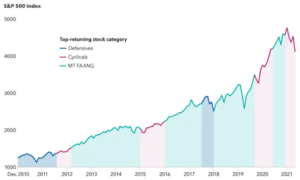
Sources: Capital Group, FactSet, MSCI, Standard & Poor’s. MT FAANG represents the collective price performance of shares of Microsoft, Tesla, Meta (Facebook), Amazon, Apple, Netflix and Alphabet (Google). Defensive stocks typically generate relatively stable returns regardless of the state of the economy or the overall markets. Cyclical stocks tend to move up or down roughly in line with economic growth or contraction cycles. Index values do not reflect the impact of dividends. Data shown as of 4/30/22.
What this means for stock markets
In my view, we are heading into a period of real change, a fundamentally different marketplace where different leadership will emerge. That’s in sharp contrast to the 2020 COVID-19 downturn, which was really just a temporary blip in a decade-plus bull market. We know this because the same stocks that led the bull market — a relatively small group of tech-related companies — did so on the way back up.
In a true market shift, the leadership coming out of a bear market is usually a new sector or a new group of companies. And it’s not necessarily the same group that led on the way down. For instance, in the current environment, energy stocks have staged a remarkable rally. Do I think the energy sector is going to drive the next bull market? I do not.
Market leaders before and after a bear market are rarely the same
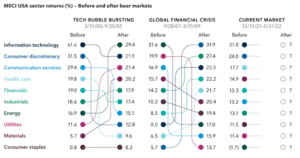
Sources: Capital Group, MSCI, Refinitiv Datastream. Returns are absolute total returns in U.S. dollars. The periods covered are: the tech bubble, December 31, 1996 to May 31, 2000 (before bear market) and September 30, 2002 to December 30, 2005 (after bear market); the global financial crisis, December 31, 2003 to September 28, 2007 (before) and May 31, 2009 to December 31, 2013 (after); and the current market, December 31, 2021 to May 31, 2022.
That said, I wouldn’t count out the FAANG (Facebook, Amazon, Apple, Netflix, Google) stocks, but I think it’s going to be a very different market going forward. It won’t be driven by a small set of stocks anymore. It won’t be characterized by growth vs. value, or U.S. vs. international. Those binary concepts don’t make sense in this environment. I think the market will be less one dimensional, and I expect a broader mix of stocks to lead us out of this downturn.
What this means for bond markets
We are also seeing a profound shift in bond markets as we reach the end of a 40-year path of falling interest rates. Sharply higher inflation levels, not seen since the 1980s, are forcing the Federal Reserve and other central banks to aggressively tighten monetary policy. The Fed is behind the curve, which means rates are probably going to move higher from here.
However, that doesn’t mean we are going back to exceedingly high inflation and interest rates. It just means that, for decades, we have lived in a declining rate environment that has been highly supportive of markets. That’s all changed. Things are likely to be more difficult going forward. But even amid these headwinds, opportunities will emerge.
Is this the end of a 40-year declining rate period?
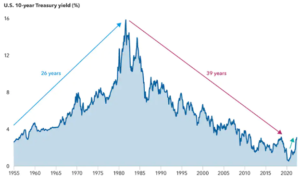
Sources: Capital Group, Refinitiv Datastream. Data shown as of 6/23/2022.
That’s one reason I like to call this era “Revenge of the Boomers,” because it’s so reminiscent of the 1960s. Interest rates moved higher, but they didn’t spike to 16% overnight. It took decades for that to happen, and there were many policy mistakes along the way. Throughout the 1960s, rates stayed in the 3% to 6% range. It was a volatile period, but overall it was still a good environment for investing. The real trouble came later. Hopefully we’ve learned some lessons from the past and we won’t repeat the 1970s.
In the meantime, it’s important to remember that higher nominal interest rates are good for savers. This is a novel concept for younger folks, but boomers grew up in a world where interest rates were sufficient to earn a decent return on savings accounts and money market funds. That’s a positive change. It makes people feel better about saving, and I see it as a solid underpinning for the market.
Over time, higher rates will also bring income back to the fixed income markets — something that has been sorely missed in the era of easy money. The importance of that shift cannot be overstated. It should eventually restore bonds to their rightful role providing diversification from equity risk.
Along those same lines, some inflation is actually a good thing. It allows well-positioned companies to raise prices, and it results in generally higher wages. That makes people feel better about their jobs and progress. It is hard to predict what will happen to real purchasing power, but we have seen in the past decade that without a little inflation, people feel like they’re not getting ahead.
What this means for investors
Maintaining a balanced, “all-weather” portfolio makes sense in any environment, but particularly this one. Earlier this year I reminded investors to keep an eye on valuations and prepare for a market correction. I remarked that I was buying a raincoat, but not putting it on yet. Turns out, it’s nice to have that raincoat handy. Market volatility has returned, but that’s no reason to be discouraged.
At Capital Group, our fundamental, bottom-up investment approach leaves us well positioned to identify specific companies that can generate strong earnings growth. We remain confident that we have the right people in place making decisions based on deep, company-specific research, which has always formed the basis of our long-term investment philosophy.
Indeed, the world has changed dramatically. But, for selective investors, change creates opportunity.
Rob Lovelace is Vice Chair and President of Capital Group as well as an equity portfolio manager with 36 years of investment experience. He holds a bachelor’s degree in mineral economics from Princeton University. He also holds the Chartered Financial Analyst® designation.
Original article: https://www.capitalgroup.com/advisor/insights/articles/rob-lovelace-all-weather-investing.html





 Invest Well. Manage Well. Live Well.
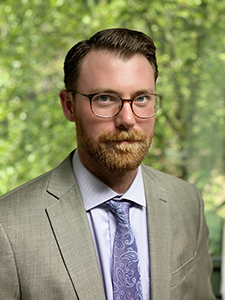 Gary is a Financial Associate at Gleba & Associates, Inc., joining our team in June 2020. After graduating from Walsh College with a Bachelor’s Degree in Finance in 2013, he began his career at Raymond James Financial Services. He then moved to the world of banking, working as a banker with Chase Private Client and then as an Assistant Vice President, Financial Advisor with PNC Investments. Gary has expertise in all aspects of financial planning including investment management, higher education planning, life insurance, and long-term care insurance needs analysis. When he gets away from the office, he loves to spend time with his wife, Lauren, and two daughters, Hadley and Harper. He enjoys woodworking, boating, summer weekends at the family cottage, spending time outdoors and traveling.
 Conor is a Financial Associate at Gleba & Associates, Inc., where he started in 2018. Conor has prior experience in the financial planning industry, as well as in the insurance industry. His high level of understanding insurance and financial products helps him in assessing the needs of our clients. He holds a Bachelor of Science degree in Business Administration with a concentration in Finance from the University of Detroit Mercy. You can often find Conor playing soccer or walking with his two dogs Milo, and Ellie. He is also an avid follower of the Detroit Tigers, Detroit Red Wings and his alma mater, the University of Detroit Mercy Titans.
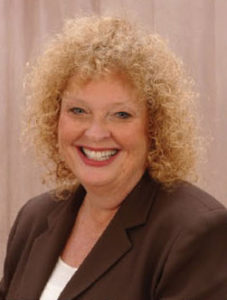 Lorie Heitzer is our Financial Associate at Gleba & Associates, Inc., where she has been a valuable employee for more than a decade! In her current role, Lorie assists with client reviews, implements client financial planning, and handles preparation of investment paperwork. During her time with Gleba & Associates, Lorie has earned her Series 6 (Investment Company Variable Contracts Representative), 63 (Uniform Securities Agent) and Life Insurance Licenses, allowing her to move into her current role where she assists clients in both of these areas. Lorie and her husband Bill, along with their daughters Lauren and Alexandria, and sons-in-law, Andrew & Joe, enjoy golf and make it a family event whenever possible. Her tenure at Gleba & Associates speaks volumes to her passion for the firm’s family atmosphere and her dedication to our clients and their financial and insurance needs.
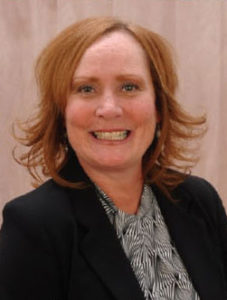 Terri is the Service Manager at Gleba & Associates, Inc., Joining the team in April, 2015. In her role, she handles client service requests and underwriting. Terri’s previous experience in 401(k) Retirement Plans, Payroll and Human Resource Administration is invaluable, allowing Gleba & Associates to grow and run efficiently. This is knowledge that can also assist our small business clients as they grow their businesses. Terri enjoys spending time with family, which includes her husband, Gerry and her two children, Vincent and Genna. She loves the outdoors and camping with family in their RV. Terri looks forward to continuing the high level of customer service you have come to expect from Gleba & Associates!
 Michael is the Marketing Manager at Gleba & Associates, Inc., where he began in August 2017. In his position, Michael creates and develops marketing strategies to enhance the image of Gleba & Associates, and helps maximize the Client-Advisor relationship. He is also in charge of company events, seminars, and educational workshops. Michael has a Bachelor of Applied Arts Degree in Integrative Public Relations from Central Michigan University. When he is not in the office, Michael can most likely be found playing billiards, playing poker, on the tennis court, or rooting on the Utica Unicorns baseball team. Michael stays active by going to the gym and going to the dog park with his Labrador-mix, Milton. His approachable attitude, along with experience in marketing, communications, and social media, makes him a valuable asset to the Gleba & Associates team.
 Moiz is our Financial Associate at Gleba & Associates, Inc., where he began in 2013 after working for Bank of America and Thomson Reuters in various financial roles. In his position, Moiz assists in the research of financial solutions in order to meet client’s needs, conducts client reviews, provides insurance quotes, offers detailed financial plans, and delivers follow-up services to our clients. Before moving to the United States in 2004, Moiz grew up in rural India, where he was raised in a family of entrepreneurs. This allowed him to quickly learn the value of financial investment. Moiz holds a Bachelor of Commerce Degree in Accounting from Gujrat University and a B.B.A. in Management and an MBA from Walsh College of Accountancy and Business Administration, where he was elected as a member of Delta Mu Delta, the International Honor Society in Business Administration in recognition of high scholastic attainment. Moiz enjoys spending time with his wife, Tasneem, son, Taha, and family. He also loves playing tennis and rebuilding computers. His expertise in the areas of banking, mortgage and taxation helps to provide our clients with distinct portfolio advice as well as overall financial direction and growth.