

June 9, 2021
Written by:
Darrell Spence, Economist
Hilda Applbaum, Portfolio Manager
Chris Buchbinder, Equity portfolio Manager
Capital Group
Remember that iconic photo signifying the end of World War II, with sailors kissing nurses in New York’s Times Square?
Don’t expect quite that much exuberance this year, but Americans are throwing open their doors, getting out of the house and starting to party like it’s 1945. To be sure, COVID remains a global public health threat and continues to spread in many countries. But in the U.S., consumers are spending again, and the American economy is awakening from its artificially induced slumber.
“We are seeing huge pent-up demand and are all likely to underestimate both its magnitude and duration,” says Chris Buchbinder, a portfolio manager for The Growth Fund of America®. “As we’ve seen in Israel, China and other countries, as you get the virus under control, new cases plummet and activity rises rapidly, so I expect the economic rebound we are seeing in the U.S. to ramp up dramatically.”
Thanks largely to rising consumer spending and trillions in government stimulus, U.S. gross domestic product rose an annualized 6.4% in the first three months of the year, and total U.S. economic output could return to pre-pandemic levels by the end of 2021, years ahead of earlier expectations.
In fact, the International Monetary Fund (IMF) expects 6.4% U.S. GDP growth for all of 2021 — more than double a January estimate of 3.1% after U.S. household income growth soared to a record 21.1% this March.
“The recovery always came down to whether there would be enough stimulus to sustain us through the shutdowns,” says Capital Group U.S. economist Darrell Spence. “And with the vaccine rollout compressing the time between stimulus and the functional end of COVID, we could see even stronger growth than the market expects today.”
Sitting on a cash stash
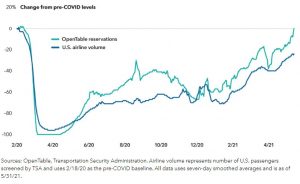
Indeed, many U.S. consumers — sitting on a cash stash and ready to spend it — have already begun to turbocharge the recovery. Aided by stimulus checks and a recovering jobs market, personal savings rates soared to 21% of disposable income in the first quarter of 2021. And there are indications that consumers, many of them fully vaccinated, are planning to use some of their stash to take long-delayed vacations or simply get out of the house and go to dinner. Bookings for domestic air travel and restaurant reservations placed through online service OpenTable have rebounded strongly.
“Our memories are marked by experiences and connectedness with other human beings, so I think travel and dining out will come roaring back,” says Hilda Applbaum, a portfolio manager and co-president of The Income Fund of America®. “But the market anticipated this. The question is, ‘Have any of these companies become even stronger because of COVID?’ ”
Many businesses in the travel and leisure industries did not take the pandemic pain standing still. Cruise lines like Royal Caribbean have established strict protocols to limit the spread of illness when sailing resumes. Companies like Hilton are buying more properties and streamlining operations. In food service, Darden, a multi-brand restaurant operator, adopted pickup service, online ordering and contactless payments.
“Some companies have used the crisis to innovate and improve,” Applbaum says. “I try to invest in those that are positioned to surpass the competition when the reopening picks up speed.”
Signs show U.S. consumers are getting out and spending
Established companies adapt to disruption
The vaccine rollout and reopening of the economy have also provided a figurative shot in the arm for many beaten down cyclical and value-oriented stocks. For the five months ended May 31, 2021, the Russell 1000 Value Index recorded an 18.4% total return, outpacing the 6.3% gain of the Russell 1000 Growth Index.
Investors want to know: Will this rotation toward value-oriented shares prove to be a lasting one?
“I do believe, as the economy opens up, more economically sensitive stocks will have their day in the sun,” says Applbaum. “And there are some value stocks that are good companies with good cash flows that can do well, but in this environment I am trying to be more discriminating.”
Many of the tech-savvy companies driving disruption have dominated headlines, but investors shouldn’t forget about old guard companies with the resources to compete and the drive to learn from their upstart competition.
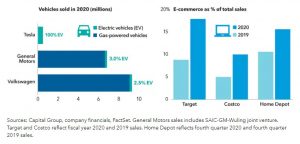
Examples are everywhere. Retailers like Target, Costco and Home Depot are ramping up their digital operations to take on Amazon. And General Motors and Volkswagen are challenging Tesla in electric vehicles.
“One investment theme that will be interesting to watch this year is whether the empire strikes back — whether these legacy companies can innovate and execute in a fiercely competitive environment,” says Carl Kawaja, a portfolio manager for The Growth Fund of America. “I would not count out the incumbents.”
Old-guard companies in autos and retail are adapting to disruption
Digital shifts continue to reshape U.S. economy
As for more growth-oriented stocks, shares of many leading digital businesses soared in 2020 but have languished in 2021. But longer term growth trends remain strong.
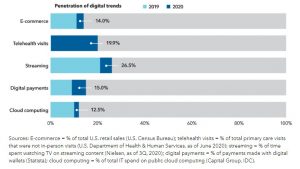
Digital payment technology, which accounted for 9% of total U.S. payments in 2019, accounted for 15% in 2020 — a 66% increase. Telemedicine, or online appointments, accounted for a fraction of total doctor visits prior to the pandemic, but about 20% of all visits in the early months of 2020. Will these behavioral shifts prove to be lasting?
“Growth may slow a bit in some areas, but I don’t believe we’ll see a reverse of these trends,” Buchbinder says. “For instance, many of the streaming companies are releasing new movies through their services at the same time they are in general release. When people physically return to theaters, will this practice stop? I don’t think so.”
Leading digital trends still have growth potential
Inflation: The elephant in the room
While the velocity of the U.S. recovery has been remarkable, it has triggered supply shortages, inflation and investor worries that it can be sustained.
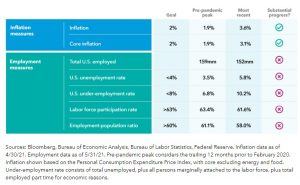
If you’re trying to buy lumber or a used car, you probably feel like inflation is out of control. “But inflation being sustained at these levels or higher certainly is not my base case,” says Ritchie Tuazon, a portfolio manager for American Funds Inflation Linked Bond Fund®.
“We saw in April that inflation basically exceeded the Fed’s target,” Tuazon explains. “But this is not due to a virtuous labor demand-driven inflation cycle. It is due to reopening of the economy and supply bottlenecks, which are more temporary. While we should continue to see inflation volatility, and I am watching inflation very closely, I expect it to subside by the end of next year.”
If history is any guide, sharp increases in prices for raw industrial materials — copper, cotton, rubber, tallow and zinc, among others — generally do not have much impact on the Consumer Price Index (excluding food and energy), the most widely used gauge of long-term inflation.
Inflation has jumped but labor data suggests it may be temporary
Investment implications
Concerns about inflation and rising rates seem overblown. Yes, we are experiencing a near-term spike in inflation but it’s likely temporary. And the Fed appears in no hurry to implement rate hikes as near-term price volatility moderates.
Value or growth? Balance them both. There might be a temptation to shift from growth stocks to value investments, but there are opportunities to invest in growing companies that are cheap and cheap companies that grow. The key is selectivity.
Some incumbent companies in industries like autos, retail and entertainment are adapting to disruptive forces reshaping the American economy.
Darrell R. Spence is an economist with 28 years of industry experience (as of 12/31/20). He holds a bachelor’s degree with honors in economics from Occidental College graduating cum laude. He also holds the Chartered Financial Analyst® designation and is a member of the National Association for Business Economics.
Hilda Applbaum is a portfolio manager with 32 years of investment experience. She holds a master’s in economics from NYU and a bachelor’s in economics from Barnard. She is also a CFA charterholder.
Chris Buchbinder is an equity portfolio manager with 23 years of investment experience. He holds bachelor’s degrees in economics and international relations from Brown.
Indexes are unmanaged and, therefore, have no expenses. Investors cannot invest directly in an index.
The Russell 1000 Growth Index measures the results of the large-cap growth segment of the U.S. equity universe.
The Russell 1000 Value Index measures the performance of the large-cap value segment of the U.S. equity universe.
Bloomberg® is a trademark of Bloomberg Finance L.P. (collectively with its affiliates, “Bloomberg”). Barclays® is a trademark of Barclays Bank Plc (collectively with its affiliates, “Barclays”), used under license. Neither Bloomberg nor Barclays approves or endorses this material, guarantees the accuracy or completeness of any information herein and, to the maximum extent allowed by law, neither shall have any liability or responsibility for injury or damages arising in connection therewith.
London Stock Exchange Group plc and its group undertakings (collectively, the “LSE Group”). © LSE Group 2021. FTSE Russell is a trading name of certain of the LSE Group companies. FTSE® and Russell® indexes are trademarks of the relevant LSE Group companies and are used by any other LSE Group company under license. All rights in the FTSE Russell indexes or data vest in the relevant LSE Group company which owns the index or the data. Neither LSE Group nor its licensors accept any liability for any errors or omissions in the indexes or data and no party may rely on any indexes or data contained in this communication. No further distribution of data from the LSE Group is permitted without the relevant LSE Group company’s express written consent. The LSE Group does not promote, sponsor or endorse the content of this communication.
Original article: https://www.capitalgroup.com/advisor/insights/articles/2021-midyear-us-outlook.html?sfid=432732599&cid=80441675&et_cid=80441675&cgsrc=SFMC&alias=E-cpy-LP-11-A2headline-Advisor





 Invest Well. Manage Well. Live Well.
 Gary is a Financial Associate at Gleba & Associates, Inc., joining our team in June 2020. After graduating from Walsh College with a Bachelor’s Degree in Finance in 2013, he began his career at Raymond James Financial Services. He then moved to the world of banking, working as a banker with Chase Private Client and then as an Assistant Vice President, Financial Advisor with PNC Investments. Gary has expertise in all aspects of financial planning including investment management, higher education planning, life insurance, and long-term care insurance needs analysis. When he gets away from the office, he loves to spend time with his wife, Lauren, and two daughters, Hadley and Harper. He enjoys woodworking, boating, summer weekends at the family cottage, spending time outdoors and traveling.
 Conor is a Financial Associate at Gleba & Associates, Inc., where he started in 2018. Conor has prior experience in the financial planning industry, as well as in the insurance industry. His high level of understanding insurance and financial products helps him in assessing the needs of our clients. He holds a Bachelor of Science degree in Business Administration with a concentration in Finance from the University of Detroit Mercy. You can often find Conor playing soccer or walking with his two dogs Milo, and Ellie. He is also an avid follower of the Detroit Tigers, Detroit Red Wings and his alma mater, the University of Detroit Mercy Titans.
 Lorie Heitzer is our Financial Associate at Gleba & Associates, Inc., where she has been a valuable employee for more than a decade! In her current role, Lorie assists with client reviews, implements client financial planning, and handles preparation of investment paperwork. During her time with Gleba & Associates, Lorie has earned her Series 6 (Investment Company Variable Contracts Representative), 63 (Uniform Securities Agent) and Life Insurance Licenses, allowing her to move into her current role where she assists clients in both of these areas. Lorie and her husband Bill, along with their daughters Lauren and Alexandria, and sons-in-law, Andrew & Joe, enjoy golf and make it a family event whenever possible. Her tenure at Gleba & Associates speaks volumes to her passion for the firm’s family atmosphere and her dedication to our clients and their financial and insurance needs.
 Terri is the Service Manager at Gleba & Associates, Inc., Joining the team in April, 2015. In her role, she handles client service requests and underwriting. Terri’s previous experience in 401(k) Retirement Plans, Payroll and Human Resource Administration is invaluable, allowing Gleba & Associates to grow and run efficiently. This is knowledge that can also assist our small business clients as they grow their businesses. Terri enjoys spending time with family, which includes her husband, Gerry and her two children, Vincent and Genna. She loves the outdoors and camping with family in their RV. Terri looks forward to continuing the high level of customer service you have come to expect from Gleba & Associates!
 Michael is the Marketing Manager at Gleba & Associates, Inc., where he began in August 2017. In his position, Michael creates and develops marketing strategies to enhance the image of Gleba & Associates, and helps maximize the Client-Advisor relationship. He is also in charge of company events, seminars, and educational workshops. Michael has a Bachelor of Applied Arts Degree in Integrative Public Relations from Central Michigan University. When he is not in the office, Michael can most likely be found playing billiards, playing poker, on the tennis court, or rooting on the Utica Unicorns baseball team. Michael stays active by going to the gym and going to the dog park with his Labrador-mix, Milton. His approachable attitude, along with experience in marketing, communications, and social media, makes him a valuable asset to the Gleba & Associates team.
 Moiz is our Financial Associate at Gleba & Associates, Inc., where he began in 2013 after working for Bank of America and Thomson Reuters in various financial roles. In his position, Moiz assists in the research of financial solutions in order to meet client’s needs, conducts client reviews, provides insurance quotes, offers detailed financial plans, and delivers follow-up services to our clients. Before moving to the United States in 2004, Moiz grew up in rural India, where he was raised in a family of entrepreneurs. This allowed him to quickly learn the value of financial investment. Moiz holds a Bachelor of Commerce Degree in Accounting from Gujrat University and a B.B.A. in Management and an MBA from Walsh College of Accountancy and Business Administration, where he was elected as a member of Delta Mu Delta, the International Honor Society in Business Administration in recognition of high scholastic attainment. Moiz enjoys spending time with his wife, Tasneem, son, Taha, and family. He also loves playing tennis and rebuilding computers. His expertise in the areas of banking, mortgage and taxation helps to provide our clients with distinct portfolio advice as well as overall financial direction and growth.